Is Standard Retail POS Better Than Specialized Pet Store Software for Independent Shops?
For a shop that only sells products, a standard retail POS is genuinely enough. But for a pet shop that also grooms or boards, a generic till cannot price a service by animal size, schedule it against staff availability, or store pet care records. Pawfora covers both halves in one system.
Most software comparisons start from the wrong question. They line up checklists: barcode scanning, receipt printing, stock counts, discount codes, a daily sales report. On that list, a standard retail POS and pet store software look nearly identical, and the generic option is usually cheaper.
So the checklist says buy the cheap one. The checklist is wrong. It treats your shop as a shelf, and a grooming or boarding shop is half a service business. A generic till has no idea a service exists.
Here is the honest version of that comparison, written from inside a system that runs both halves.
The Short Answer: It Depends on What You Sell
If your shop only sells products, a standard retail POS is fine. Buy the cheap one, put the difference into stock, and stop reading.
If you groom, board, or run daycare, you sell time on a table. The till is only half your day. The other half is a calendar, a pet's file, and a groomer's hands. Software that understands products and nothing else leaves all three on paper, and paper stops working the moment you hire a second groomer.
That is the whole argument. Everything below is detail.
What a Standard Retail POS Genuinely Does Well
It would be dishonest to pretend otherwise, because the retail half of pet store software is ordinary retail software, and it should be.
You need product variants, categories, brands, and suppliers. Goods receiving, stock counts, stock movements, inventory valuation. Returns with a reason code. Invoices with tax rates and payment methods. A checkout that reprices every line on the server, so a tampered browser cannot invent its own total.
If you have run a generic POS, you already know how to run this half of the shop. Nothing about pet retail changes how a barcode behaves.

Where a Generic POS Falls Short for Pet Shops
Three things break, and they all break at the same moment: the second your shop stops being a shelf.
1. Price. A generic till looks up a line in a product table. A groom is not a product. It is a service, a pet, a groomer, and a slot on a calendar, and the price moves with the animal. A Labrador full groom and a Chihuahua trim are not the same job, and neither is the same job on a Saturday in December.
2. Time. A generic till records a sale after it happens. It cannot hold a table for forty minutes next Tuesday with the one groomer who is confident with anxious dogs.
3. The animal. A generic till remembers what a customer bought. It has nowhere to put the fact that this dog snaps when you reach for his back legs, and no way to show that to the person who has to touch him.
You can work around all three. Shops do it with a paper calendar, a notebook of handling notes, and a binder of vaccine cards. Then the second groomer arrives, and the workaround stops scaling.
4 Ways Specialized Pet Store Software Outperforms a Generic POS
1. Tiered Service Pricing Based on the Animal
This is where a generic till gives up first, because a service needs a price that varies by the pet standing in front of you.
In Pawfora a service is priced in tiers, and you write the tiers the way you actually talk: by weight (Small, Medium, Large), or by coat (short, long-curly). Each tier carries its own price. A single-price service is just a service with one default tier. The service itself owns the parts that do not change per tier: how long it takes, which pets it applies to, which staff are cleared to perform it, whether it is taxable, and what your tax is called, because that label is GST in one country and sales tax in another.
Two details that sound small and are not. Each service carries a duration, so a ninety-minute doodle coat does not get booked into a thirty-minute gap. And a service can carry a weekend surcharge, which is charged to the client, while a separate weekend rate goes to the groomer as commission without touching what the client pays.
2. Scheduling That Knows About Staff, Not Just Registers
A generic POS closes a sale. A grooming shop has to arrange the sale before it happens, and the arrangement has rules.
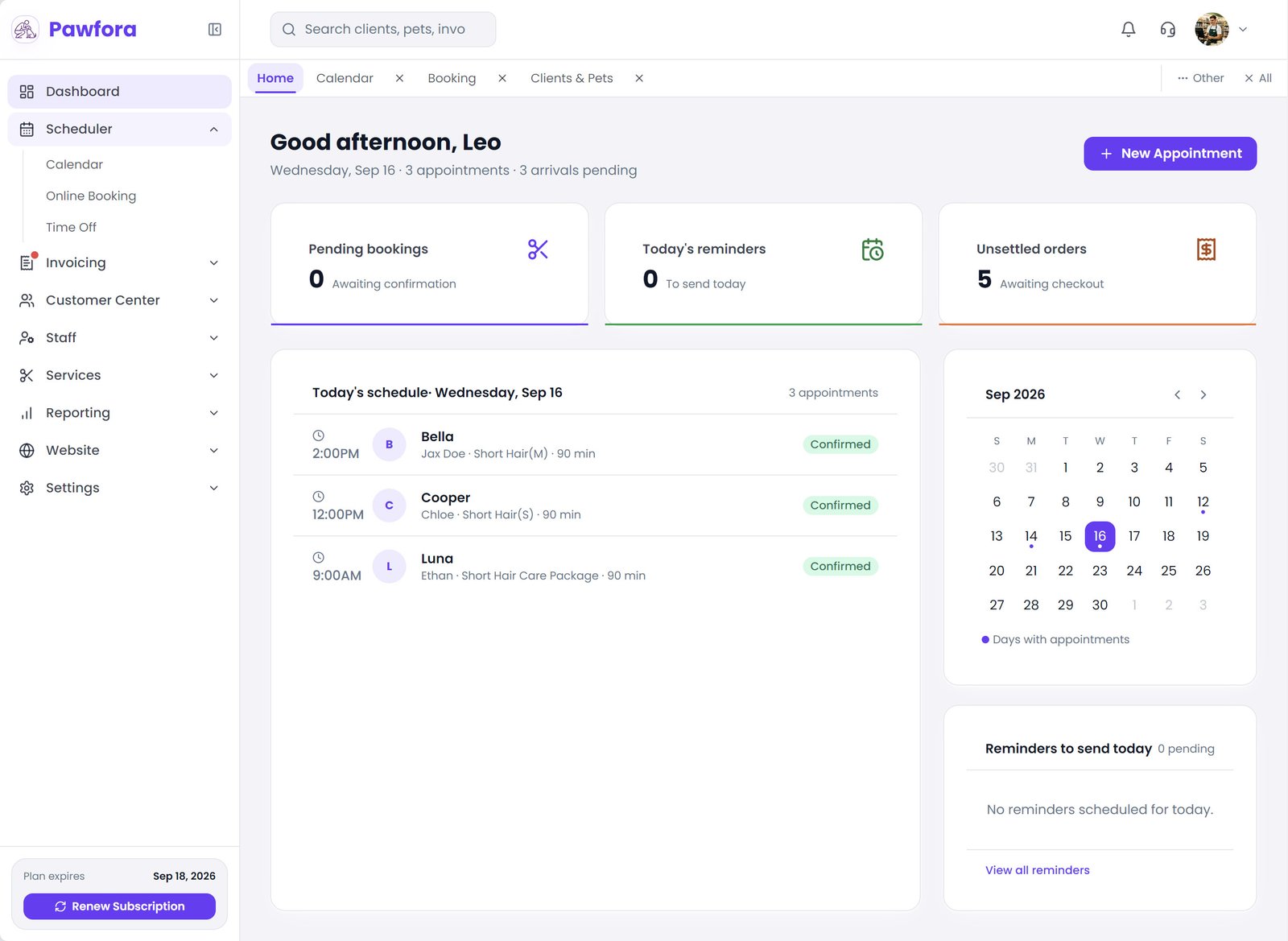
Our scheduler checks your business hours, staff time off, which staff are authorized for which service, and whether that groomer is already booked. It holds the pet, the service, and the staff member together on one appointment, because a full groom for two dogs by one groomer is a different afternoon than the same two dogs by two people. A completed appointment locks, so last Tuesday's finished groom cannot be quietly edited into a different number. A no-show is recorded as a no-show, which is how you find out that your 9 a.m. slot is a problem.
Clients can book themselves. The booking page shows real availability from the same rules, and services you have not marked as online bookable stay out of it. The client sees their own bookings in their account and can cancel one, which is a small thing that saves your front desk a phone call.
3. The Customer Record Is a Pet, Not a Basket
This is the difference no checklist captures. In a generic POS the customer record is a purchase history. In a pet shop the customer record is an animal, and the animal outlives the visit.
Pawfora keeps one profile per pet, under the client. Free-text notes for the things that need a sentence, and reusable colour-coded tags for the things that need one second of attention: bite risk, anxious, escape artist, senior, noise sensitive. Vaccinations with the date given and the expiry date. Deworming with the next due date. A pre-check at the start of every groom, logged by body area, where anything that is not simply healthy is flagged automatically and rolls up into a count on the pet's page.
The groomer's report, photos included, goes to the same profile, and the owner can read it in their own account. So the dog's file walks into the grooming room before the dog does, and the person holding the clippers is not the only one who knows what happened last time.
One honest boundary: this is the history a grooming business actually uses, not a clinic-grade medical record. It will not replace your vet.
4. One Cart, Two Worlds
The clearest test of a pet-specific till is the receipt. A client books a full groom, and while they wait they buy a bag of food and a bottle of shampoo. That is one sale, and it has to survive everything a retail sale survives.
Our checkout handles a mixed cart of products and services in a single transaction. Every line is repriced on the server from the database, so a tampered browser cannot invent its own total. A coupon is resolved at the till and counted against the subtotal. A manual discount is clamped so it can never exceed what is owed. Tax is charged on the discounted amount, pro rata, which is the difference between a receipt that balances and one that does not. Tips are recorded on the payment and flow into payroll and staff reports.
The service line carries the pet. The receipt says which dog was groomed, not just that a groom was sold, and that is what makes the follow-up reminder make sense three weeks later.
Stock is checked twice: once before the sale, and again inside the transaction with a row lock, because two tills selling the last bag of food at the same moment is a real event. A gift still leaves the building, so it consumes inventory exactly like a paid line. And when a sale is voided, the stock goes back and the reminders that sale created are removed with it.
Financial Reporting: Separating Your Two Businesses
A generic POS gives you one revenue number. A pet shop runs two businesses with different margins, and blending them hides which one is working.
Our financial reporting splits net service revenue from retail product revenue, keeps tips separate from both, and compares each against the previous period. Staff attribution follows the same split, because a commission rule for a full groom and a commission rule for a bag of kibble are different numbers, and a groomer who is excellent at one is not automatically paid for the other.
If you have ever wondered whether the retail wall pays for itself, or just pays for itself to stand there, this is the screen that answers it.
5-Point Checklist Before You Buy Any POS
Before you choose software for your shop, ask the provider five questions:
- Can the till sell a service and a product on the same receipt, and still get stock right?
- Can a service price vary by the animal, without a manual override at the register?
- Does the calendar refuse to double-book a groomer, and does it respect time off?
- Does the pet's record follow the animal between visits, and can the owner read it?
- Does the report separate service revenue from retail revenue?
Most generic tills fail four of those five. Most pet systems pass all five and cost more per month. The question is whether the service half of your shop earns back the difference, and in a shop that grooms, it usually does inside a month or two.
Two things we do not do, so you are not surprised later. Our loyalty programs are buy-a-number-get-one rules you define, with no per-customer progress counter yet. And reminders are created automatically at checkout when a service asks for one, but they are sent by a person, by email, not blasted out on a timer.
The Short Version
A standard retail POS is better for a shop that sells things. A pet shop that grooms or boards sells services to animals, and the till is only half of that. The other half is the calendar, the groomer's hands, and the pet's file, and software that cannot see those three will keep them on paper until the paper stops working.
Ready to see both halves in one system? Stop running your service business on a wall calendar and your retail business on a till that has never heard of a dog. See how Pawfora handles mixed carts, service tiers, appointment rules, and the pet file behind them, with retail inventory and reporting underneath.
See it on your own shop
Every module is unlocked for 7 days. Set up your services and take a real booking before you decide anything.
No credit card required · Cancel anytime